AI and agency intelligence
About this post
Author
Alec McLeod
Role
AI & Product Manager
Published
October 27, 2026
Read time
8
Category
AI and agency intelligence
As AI & Product Manager for Function Software, I spend a lot of time with creative agencies, and I hear a lot of requests: better reporting, a smarter Gantt, one more integration (there's always one more integration).
But one comes up more than any other, and it rarely arrives as a feature request. It usually comes out as a frustrated aside, halfway through a conversation about something else.
The clearest version I've heard was on a visit to a mid-size, full-service agency in Canada. Separate account, project and finance teams, each owning their own part of every job.
The owner walked me through how a job moved through the agency, and right in the middle of it was a spreadsheet. It sat between the brief and the estimate, between the estimate and the schedule, and between the schedule and the invoice, filling the gaps their systems didn't. Someone kept it up to date by hand, and then someone else copied it into the next system.
Partway through, the owner stopped and asked: "Why am I typing this again?"
That's the request, in their words. Nobody in that room was asking for AI or for automation. They wanted to stop entering the same information twice (or, as it turned out, four times).
Here's roughly what a single project looks like at most agencies I've worked with.
A brief arrives. Sometimes it's a tidy document, but more often it's an email thread, a deck and a call where the important details came out in the last five minutes. Someone reads all of that and builds an estimate line by line, deciding which services, how many hours and at what rate.
The client approves it, and a project manager rebuilds that same scope as a schedule with phases, tasks and dates. Then they work out who's actually free to do the work, which usually means another screen, another report or a walk around the studio.
The work gets done and time gets tracked against it. Then someone in finance builds the invoice, looking back at the estimate and the time to work out what to bill.
So one job gets entered four times, by three or four different people, and every handoff is a chance for something to get lost. The client's "must be live before the trade show" becomes a date nobody carried across. A service gets quoted but never scheduled. An invoice goes out light because nobody connected it back to the estimate.
None of the people involved are doing anything wrong. They're doing what their software asks of them, which is exactly the issue.
At that agency, the cost was easy to see once the owner pointed at it. Senior people were losing hours every week moving information from one place to another instead of doing client work. Jobs went over because something sold on the estimate never made it onto the schedule. And good people were tired of being data-entry clerks.
If this was such an obvious request, it's fair to ask why nobody fixed it.
Honestly, I didn't have a good answer for that owner. In 50+ years alongside agencies, between Function Point and FunctionFox, we've built a lot of shortcuts for exactly this: templates, copying a previous job, imports, converting an estimate into a schedule. They all help, and agencies use them every day. None of them would have got rid of that spreadsheet.
A shortcut still needs someone at the keyboard. Every agency management tool, ours included, was built as a system of record. Its job is to store what you tell it accurately and give it back to you in a report. That's useful, and it's also why the typing never went away. The software could hold the information, but it couldn't read a brief, work out what the client was asking for and turn that into the next step. A person had to do that part every time, at every handoff.
That's what has changed. Software can now read a messy brief, pull out what matters and draft the next step for a person to check. You can't really bolt that onto a system of record, because it changes what the software is for. That's why we built Frankly from the ground up as an AI-native platform, with agents built into everything you run the agency on, rather than adding a chat window to what we already had.
Here's the same job in Frankly.
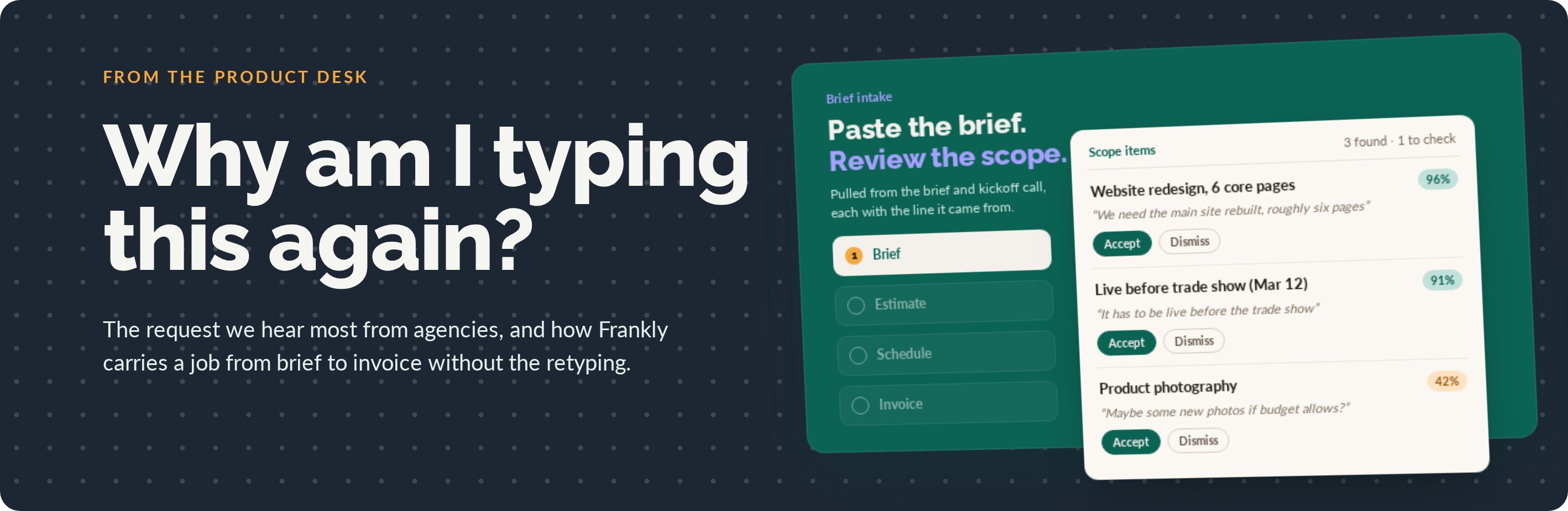
It starts with the brief. Paste in whatever the client gave you (a proposal, a transcript of the call or your own notes) and Frankly pulls out the outcomes and scope items the client asked for. Each one quotes the line it came from, with a confidence score, so you can see why it's there and spot what it wasn't sure about. Nothing goes onto the estimate until you've reviewed and accepted it.
From there you can ask the agent to draft the estimate itself, priced from your own services and rates, and see the margin on each line as you adjust it. You're editing a draft rather than starting from a blank page.
Once the estimate is approved, you build the schedule straight from it. The phases and services carry across, so the scope you sold is the scope you schedule. (If you'd rather start from a similar past job, a template or a plan in a spreadsheet, those options are there too.) You can also ask the agent to lay out the schedule for you, including phases, dates and task placement.
When you assign a task, you can see who's available for those dates, including time off and office closures, without checking a separate calendar. The capacity view shows the whole team's load in one place. And if you'd rather just ask, the agent will propose the task changes and assignments for you to accept.
When it's time to bill, the finance agent drafts the invoice from the project or the retainer, and you review, adjust and send it.
To make that a bit more concrete, picture that agency's next job.
The client sends a brief and there's a kickoff call. Instead of someone reading both and starting the spreadsheet, the account lead pastes the brief and the call transcript into Frankly. What comes back is the list of outcomes the client asked for, each with the client's own words beside it. A couple are flagged as low confidence because the client was vague on the call, which is useful in itself, since those are the questions to go back to the client with before quoting.
They ask the agent to draft the estimate, and it comes back priced from the agency's own services and rates. They adjust a couple of lines, watch the margin move and send it.
When the client approves, the project manager builds the schedule from the estimate. Everything that was sold is already there as phases and tasks, so nothing has to survive a copy and paste. When they assign the work, they can see who's actually free those weeks.
At the end of the month, the finance lead asks for the invoice, and there's a draft waiting for review, built from the project rather than pieced together from memory.
It's the same agency doing the same work. Nobody has to be the bridge between systems anymore, and there's no spreadsheet in the middle.
One thing runs through all of this, and it's deliberate: the agents draft, and a person decides. Every change an agent proposes shows up as something you accept or dismiss, and every record shows when an agent was involved. Your people stay in charge of the work. They just stop being the ones who copy it from one place to the next.
In an agency, that matters more than almost anywhere else. An estimate is effectively a promise to a client, and an invoice is a conversation about money. Nobody I've worked with wants software making those calls on its own, and they shouldn't have to trust it blindly to get the time back. Reviewing a good draft is a lot less work than building one from scratch, and the judgement stays with the person who has the client relationship.
That's what we mean when we say Frankly does the admin. People stay on the parts of the job that need them, and the retyping between those parts goes away.
I think about that spreadsheet a lot. It wasn't a bad idea; it was a smart team working around software that couldn't carry the work from one step to the next. That owner hasn't seen Frankly yet. When they do, I'm hoping what they notice most is what's missing: the gap the spreadsheet used to fill, and the hours their people spent keeping it up to date.
Frankly is built to keep getting better, and this request is a good example of why. Every agency's version of "typing it again" is a little different, and what agencies tell us about where the friction still is shapes what we work on next.
If you're running on Function Point today, nothing changes until you want it to. Function Point continues to be sold and supported, and when you're ready, there's a guided migration to Frankly.
And if you've ever caught yourself asking why you're typing this again, I'd like to hear about it.
What is double data entry in an agency? It's when the same job information, such as scope, hours, rates and dates, gets typed by hand into more than one place as a job moves from brief to estimate, schedule and invoice. At many agencies, a single job is entered four times by three or four different people.
Why do agencies re-enter the same project data? Most agency management software was built as a system of record: it stores what you enter and reports it back. Shortcuts like templates, copying a past job and converting an estimate into a schedule help, but someone still has to read the brief and turn it into the next step at every handoff.
What does double data entry cost an agency? Senior people lose hours every week moving information between systems instead of doing client work. Scope sold on an estimate never makes it onto the schedule, invoices go out light because nobody connected them back to the estimate, and good people get tired of being data-entry clerks.
Can AI build an agency estimate from a client brief? In Frankly, you paste in a brief, call transcript or notes, and it pulls out the outcomes and scope items the client asked for, each with the line it came from and a confidence score. Once you've reviewed and accepted them, the agent can draft an estimate priced from your own services and rates. A person reviews and decides at every step.
Ready when you are
Tell us how you run projects, time, and billing. We will walk you through what your week looks like without the overhead.
Let's Talk
The operational layer for creative agencies, so the work that matters gets the room it needs.
© Function Software Inc. 2026
